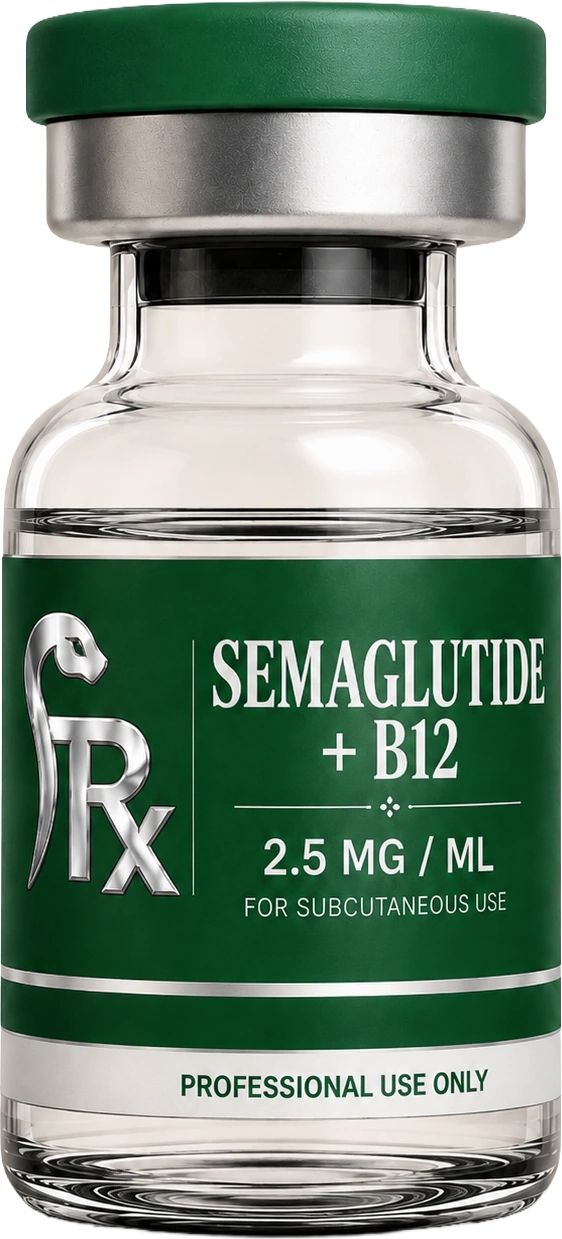
A compounded weekly injection that pairs semaglutide — the clinically proven GLP-1 — with vitamin B12, commonly included to support energy and help ease nausea. Prescribed online, shipped from U.S. compounding pharmacies to all 50 states.
One flat price — the same at every dose
$299/mo Every dose, one price
A few private questions, then a licensed provider reviews your answers.

Semaglutide + B12 is a compounded weekly injection that combines semaglutide — a GLP-1 receptor agonist used for medically-supervised weight loss — with vitamin B12, prepared for each individual patient by a U.S. 503A compounding pharmacy. Because it combines ingredients, it is made per prescription rather than sold as a fixed off-the-shelf product.
Semaglutide is the part that drives the weight-loss effect: it mimics a natural gut hormone that curbs appetite and helps regulate blood sugar. The vitamin B12 is commonly added to support energy and to help some patients tolerate the nausea that can accompany a GLP-1, especially during the early titration weeks.
It is designed for one simple routine — a single subcutaneous injection on the same day each week, with the dose stepped up gradually. Your provider builds the titration plan around your body, your history, and your goals during your online visit.
Because appetite is driven by biology, not just discipline — hunger hormones, blood-sugar swings, and a body that defends its set point all push back against dieting. GLP-1 medications like semaglutide work on that underlying biology: they mimic a gut hormone that signals fullness, slow how quickly the stomach empties, and steady blood sugar, so eating less feels natural instead of like a constant fight.
Excess weight is influenced by genetics, hormones, medications, and metabolism. Treating it with a provider-supervised medication is a legitimate clinical approach, not a shortcut.
Nausea and low energy are the most common early hurdles on a GLP-1. Vitamin B12 is commonly added to help support energy and ease that transition while the dose titrates up.
The short answer: diet and exercise change your inputs, over-the-counter supplements make claims with little clinical backing, and a prescription GLP-1 works on the appetite biology itself — under the supervision of a licensed provider.
| Diet & exercise alone | OTC weight supplements | Compounded GLP-1 + B12 (Rx) | |
|---|---|---|---|
| What it targets | Calories in / calories out | Vague "metabolism" claims | Appetite and blood-sugar biology |
| How you take it | Daily habit change | Daily pills or powders | One weekly injection |
| Clinical evidence | Effective but hard to sustain | Little to none | Semaglutide is a well-studied GLP-1 |
| Provider involved | No | No | Yes — reviews your health history first |
| Addresses hunger hormones | No | No | Yes — that is the mechanism |
Most people try diet and exercise first, find the weight comes back as hunger returns, and cycle through supplements that do little. A provider-supervised GLP-1 is the next step up: it works on the biology that makes eating less so hard to sustain.
It works by mimicking a natural gut hormone — curbing appetite, slowing digestion, and steadying blood sugar — while the added B12 supports energy and helps ease nausea during titration.
The GLP-1 component mimics a natural gut hormone that signals fullness to your brain and helps regulate appetite.
It slows stomach emptying and acts on appetite centers, so you feel satisfied sooner and blood sugar stays steadier.
Vitamin B12 is commonly added to support energy and to help some patients with GLP-1-related nausea during titration.
It's for adults pursuing medically-supervised weight loss who want the proven weekly GLP-1 — and may benefit from added B12 for energy or nausea support.
You want a clinically proven GLP-1 with a provider guiding the plan, not a supplement or a fad.
One injection a week, on the same day — no daily pill to remember and no complicated regimen.
If a prior GLP-1 left you drained or queasy, the added B12 is commonly included to help support energy and tolerance.
Already on a GLP-1 and want to move your care and refills to ForbiddenRx — mention it in your visit.
If you prefer the plain GLP-1 without the added B12, Semaglutide may fit better. And it's not appropriate for anyone with a personal or family history of medullary thyroid cancer or MEN2, a history of pancreatitis, or a known allergy to B12 — those need evaluation before starting. Share your full history in your visit.
You complete a private online visit, a licensed provider reviews it, and — if appropriate — your compounded medication ships to your door. No insurance required, no in-person appointment, no waiting room.
A few private questions about your health, weight, and goals, on your own time.
A provider licensed in your state reviews your information and, if appropriate, writes a prescription and sets your titration schedule.
Shipped from a U.S. 503A pharmacy in plain, unmarked packaging to all 50 states. Automatic refills available, and you can message your care team anytime.
Pricing is shown at checkout — no insurance needed, no hidden fees.
You take one subcutaneous injection per week on the same day, with the dose stepped up gradually, and your provider sets the exact schedule for you. Most side effects are mild, gastrointestinal, and ease as your body adjusts.
Semaglutide + B12 is not for those with a personal or family history of medullary thyroid cancer (MTC) or MEN2, or a history of pancreatitis. Tell your provider about your full medical history, allergies (including to B12 or cobalamin), and every medication you take before starting.
Common side effects are usually mild and gastrointestinal, and often ease as your body adjusts. They may include:
Start at the dose your provider sets and follow the titration schedule. Seek immediate care for severe or persistent abdominal pain (a possible sign of pancreatitis) or for any signs of an allergic reaction such as swelling or trouble breathing.
A side-by-side look at the medically-supervised weight-loss options available through ForbiddenRx. Your provider helps you choose what's right.
| Treatment | What it is | Focus | Form | For | Rx required |
|---|---|---|---|---|---|
| Semaglutide + B12 Popular | A compounded weekly GLP-1 with vitamin B12 | Appetite & energy support | Weekly injection | Adults | Yes |
| Semaglutide | The clinically proven weekly GLP-1 | Appetite & weight | Weekly injection | Adults | Yes |
| Tirzepatide | A dual GIP + GLP-1 agonist | Appetite & weight | Weekly injection | Adults | Yes |
| Oral Semaglutide | A daily GLP-1 tablet, no needles | Appetite & weight | Daily tablet | Adults | Yes |
Vitamin B12 is commonly included in compounded semaglutide formulations to help support energy and to help some patients tolerate the nausea that can come with a GLP-1, especially during titration. The semaglutide is what drives appetite and blood-sugar effects.
Yes. Because it combines semaglutide with B12, this formulation is prepared for the individual patient by a 503A compounding pharmacy under a valid prescription. Compounded preparations are not FDA-approved products.
It's a once-weekly subcutaneous injection taken on the same day each week, with the dose titrated up gradually. Your provider sets the schedule.
Yes. After your online visit, a licensed provider reviews your information. A prescription is not guaranteed and is subject to provider review of your health history.
It's not appropriate for people with a personal or family history of medullary thyroid cancer (MTC) or MEN2, or a history of pancreatitis, among other conditions — or anyone with a known allergy to B12 (cobalamin). Share your full medical history with your provider.
Yes. Your consultation is confidential and medication ships in discreet, unmarked packaging. Your information is handled in accordance with applicable privacy standards.
U.S. board-certified clinicians
U.S.-based compounding partners
Nationwide telehealth coverage
Complete a quick online visit. A licensed provider reviews your information and, if appropriate, your semaglutide + B12 ships to your door.
Medically reviewed by ForbiddenRx Medical Affairs — Independent, licensed medical providers · Last reviewed July 2026. This page was written and is periodically reviewed for medical accuracy in line with clinical guidance followed by the independent, licensed medical providers in the ForbiddenRx network. It is provided for general educational purposes and is not a substitute for professional medical advice, diagnosis, or treatment. Always talk with a licensed provider about your individual health.
This page is educational and is not medical advice.