Subcutaneous injectables that keep the testes active — often added to testosterone therapy to help preserve sperm production and testicular size. Prescribed online after real bloodwork and reviewed by a licensed provider.
Your price depends on the dose your provider prescribes
$35/mo Most people start here
A few private questions and real bloodwork, then a licensed provider reviews your labs and goals.

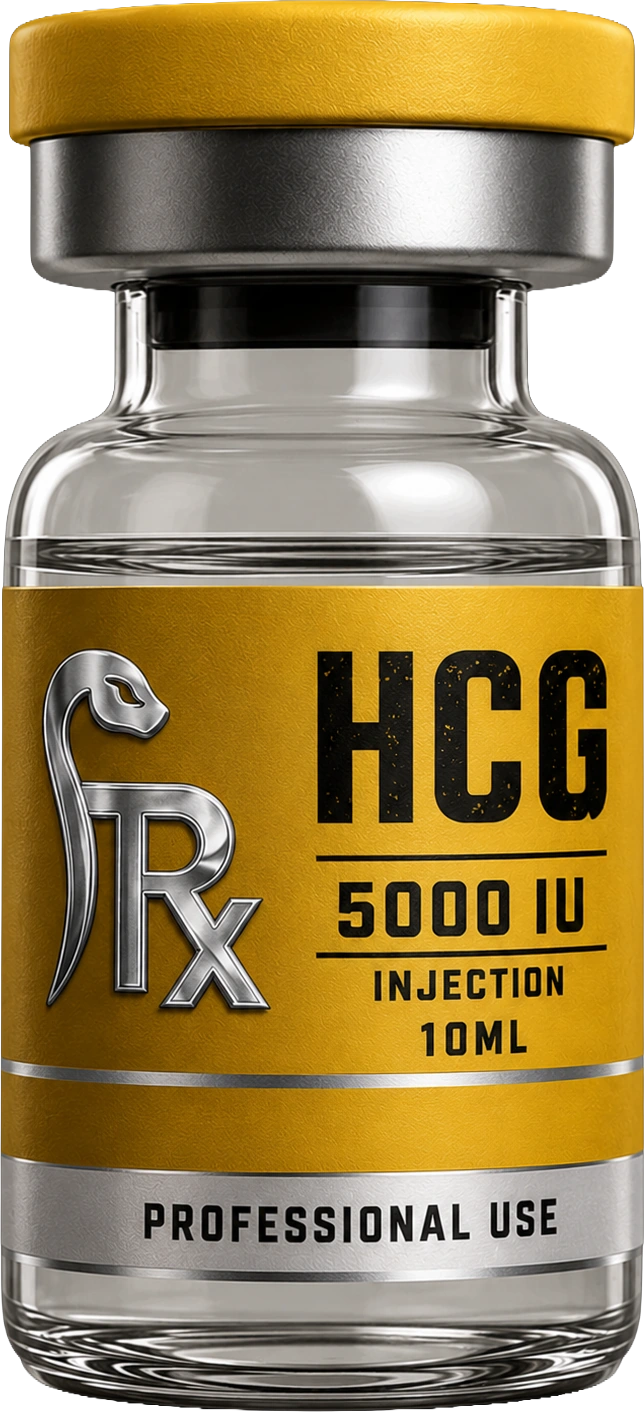
HCG and gonadorelin are subcutaneous injectables that keep the testes active — HCG (human chorionic gonadotropin) mimics luteinizing hormone and signals the testes directly, while gonadorelin is a GnRH analog that prompts the pituitary to release LH and FSH, working one step higher up the same hormone axis.
They are most often added to testosterone therapy, which can otherwise quiet the body's own signal and shrink the testes over time. Guided by symptoms plus bloodwork, they help preserve sperm production and testicular size, and are also used to support fertility.
The right choice between HCG and gonadorelin depends on your labs, goals, and your provider's clinical judgment. Both may be prescribed as compounded preparations, prepared per prescription by a U.S. 503A compounding pharmacy.
Testosterone therapy adds testosterone from outside the body, which can signal the testes to slow down — often reducing sperm production and testicular size over time. That's a well-documented effect of TRT: the body senses plenty of testosterone in circulation and quiets its own signal to the testes, so they produce less and can shrink while therapy continues.
Left unaddressed, testicular suppression tends to persist for as long as you stay on testosterone alone — it's not something that self-corrects while therapy continues.
Adding HCG or gonadorelin keeps the testes stimulated, which is why it's a common companion to TRT for men who want to keep fertility and testicular size on the table.
The short answer: testosterone alone can suppress your own production, enclomiphene raises your own testosterone through the pituitary, and HCG or gonadorelin keeps the testes directly stimulated to help protect fertility and size while you stay on therapy.
| Testosterone alone | Enclomiphene | HCG / gonadorelin (Rx) | |
|---|---|---|---|
| What it does | Adds testosterone from outside the body | Stimulates your own testosterone via LH and FSH | Keeps the testes active to help maintain fertility and size |
| Effect on fertility | Can suppress sperm production | Preserves your own axis | Supports fertility on testosterone therapy |
| Cadence | Weekly / daily | Daily oral | Per protocol |
| Needle | Varies | No | Yes |
| Guided by labs | Yes | Yes | Yes — provider reviews bloodwork first |
| Rx required | Yes | Yes | Yes |
Many men on testosterone therapy add HCG or gonadorelin specifically to keep the testes active rather than idle. Which one fits — and whether it belongs alongside your current plan — is a decision your provider makes from your labs and goals.
It keeps the testes active — either directly, in the case of HCG, or by prompting the pituitary, in the case of gonadorelin — so they keep producing while you stay on testosterone.
HCG mimics luteinizing hormone (LH) and acts directly on the testes, keeping them producing rather than going idle.
Gonadorelin is a GnRH analog that prompts the pituitary to release LH and FSH — one step higher up the same hormone axis.
Your provider sets and adjusts the protocol on real bloodwork, so treatment tracks your own testosterone, LH, and FSH numbers.
It's for men who are on or considering testosterone therapy and want to preserve their fertility or testicular size — and for men seeking fertility support.
Testosterone therapy can suppress fertility and shrink the testes; HCG or gonadorelin helps keep them active while you stay on treatment.
Frequently chosen to support ongoing sperm production — for men who want to conceive now or later.
By keeping the testes stimulated, these injectables help counter the shrinkage that can accompany testosterone therapy.
The plan is confirmed by symptoms plus bloodwork — not by symptoms alone — and adjusted as follow-up labs come back.
If your main goal is raising testosterone without needles, Testosterone therapy or enclomiphene may fit better — your provider can help you choose. And if you have undiagnosed symptoms or conditions that need evaluation, mention them in your visit before starting any therapy.
You complete a private online visit and real bloodwork, a licensed provider reviews your labs and goals, and — if appropriate — your prescription ships to your door. No insurance required, no in-person appointment, no waiting room.
A few private questions, then get your testosterone, LH, FSH, and related markers tested so your provider has real numbers.
A provider licensed in your state reviews your symptoms, labs, and fertility goals and, if appropriate, builds your HCG or gonadorelin protocol.
Shipped from a U.S. pharmacy in plain, unmarked packaging to all 50 states. Refills keep you on schedule, and you can message your care team anytime.
Pricing is shown at checkout — no insurance needed, no hidden fees. Prescription approval is not guaranteed and is subject to provider review.
You give a small subcutaneous injection on the schedule your provider sets — often several times per week — and your provider sets and adjusts the exact dose from your bloodwork. These are prescription medications that need ongoing oversight.
HCG and gonadorelin are prescription medications that require ongoing provider oversight and periodic bloodwork. Tell your provider about all conditions and medications before starting. They may be prescribed as compounded preparations.
Your provider monitors you with regular labs and watches for possible side effects, including:
Tell your provider about all conditions and medications, and seek care for any new or worsening symptoms. Your provider can adjust your protocol or pause treatment based on how your follow-up labs and symptoms track.
A side-by-side look at the men's hormone-health options available through ForbiddenRx. Your provider helps you choose what's right for your labs and goals.
| Treatment | What it is | Focus | Form | Rx required |
|---|---|---|---|---|
| HCG / Gonadorelin Popular | Injectables that keep the testes active | Fertility & testicular support | Injection | Yes |
| Testosterone | Testosterone replacement therapy for low levels | Low testosterone | Injection or cream | Yes |
| Enclomiphene | Oral SERM that raises your own testosterone | Fertility-friendly T support | Oral tablet | Yes |
| Anastrozole | Controls estrogen conversion in men on TRT | High estradiol on TRT | Oral tablet | Yes |
HCG (human chorionic gonadotropin) mimics luteinizing hormone (LH) and signals the testes directly to stay active. Gonadorelin is a GnRH analog that prompts the pituitary to release LH and FSH, working one step higher up the same hormone axis. Both are subcutaneous injectables used to keep the testes producing — which is why they're used to preserve fertility and testicular function.
Testosterone therapy adds testosterone from outside the body, which can signal the testes to slow down — often reducing sperm production and testicular size over time. Adding HCG or gonadorelin keeps the testes stimulated while you stay on testosterone, which is why it's a common companion to TRT. Your provider decides whether it fits your labs and goals.
HCG and gonadorelin are frequently chosen specifically to help preserve fertility. By keeping the testes stimulated rather than idle, they support ongoing sperm production — including for men on testosterone therapy and men who want to conceive now or later. Discuss your fertility goals with your provider, who monitors your response with bloodwork.
HCG mimics LH and acts directly on the testes. Gonadorelin is a GnRH analog that works one step higher — it prompts the pituitary to release LH and FSH, which then signal the testes. Both keep the testes active; the right choice depends on your labs, goals, and your provider's clinical judgment. Both may be prescribed as compounded preparations.
Yes. Hormone therapy is guided by real lab testing, not a questionnaire. Bloodwork gives your provider a baseline — including testosterone, LH, FSH, and estradiol — and guides your starting protocol; follow-up labs then track how you respond. Your provider monitors for possible side effects such as injection-site reactions, water retention, changes in estradiol, mood changes, and gynecomastia risk if estradiol rises. These are prescription medications that require ongoing provider oversight and may be prescribed as compounded preparations.
After your online visit and bloodwork, a licensed provider reviews your information. If HCG or gonadorelin is appropriate, your prescription ships discreetly to your door in unmarked packaging, with refills to keep you on schedule. Prescription approval is not guaranteed and is subject to provider review.
U.S. board-certified clinicians
U.S.-based compounding partners
Nationwide telehealth coverage
Testosterone therapy can quiet your own signal over time. Complete a quick online visit and real bloodwork, and a licensed provider takes it from there.
Medically reviewed by ForbiddenRx Medical Affairs — Independent, licensed medical providers · Last reviewed July 2026. This page was written and is periodically reviewed for medical accuracy in line with clinical guidance followed by the independent, licensed medical providers in the ForbiddenRx network. It is provided for general educational purposes and is not a substitute for professional medical advice, diagnosis, or treatment. Always talk with a licensed provider about your individual health.
This page is educational and is not medical advice.